PLA vs PETG vs ABS: Choosing Filament for Everyday-Carry Items
Three letters decide whether your 3D-printed keychain survives summer in a hot car or warps into a crisp by July. PLA, PETG, ABS — each has different physics, different feel, and different failure modes. Here's how we choose, and why Tapora prints in the materials we do.
By Tapora team
Three letters decide whether your 3D-printed keychain survives summer in a hot car or warps into a crisp by July. PLA, PETG, ABS — each has different physics, different feel, and different failure modes. Here's how we choose, and why Tapora prints in the materials we do.
PLA — the easy default
PLA (polylactic acid) is the most popular 3D printing filament, made from corn starch. It prints crisp details, comes in every colour imaginable, and is genuinely biodegradable under industrial composting.
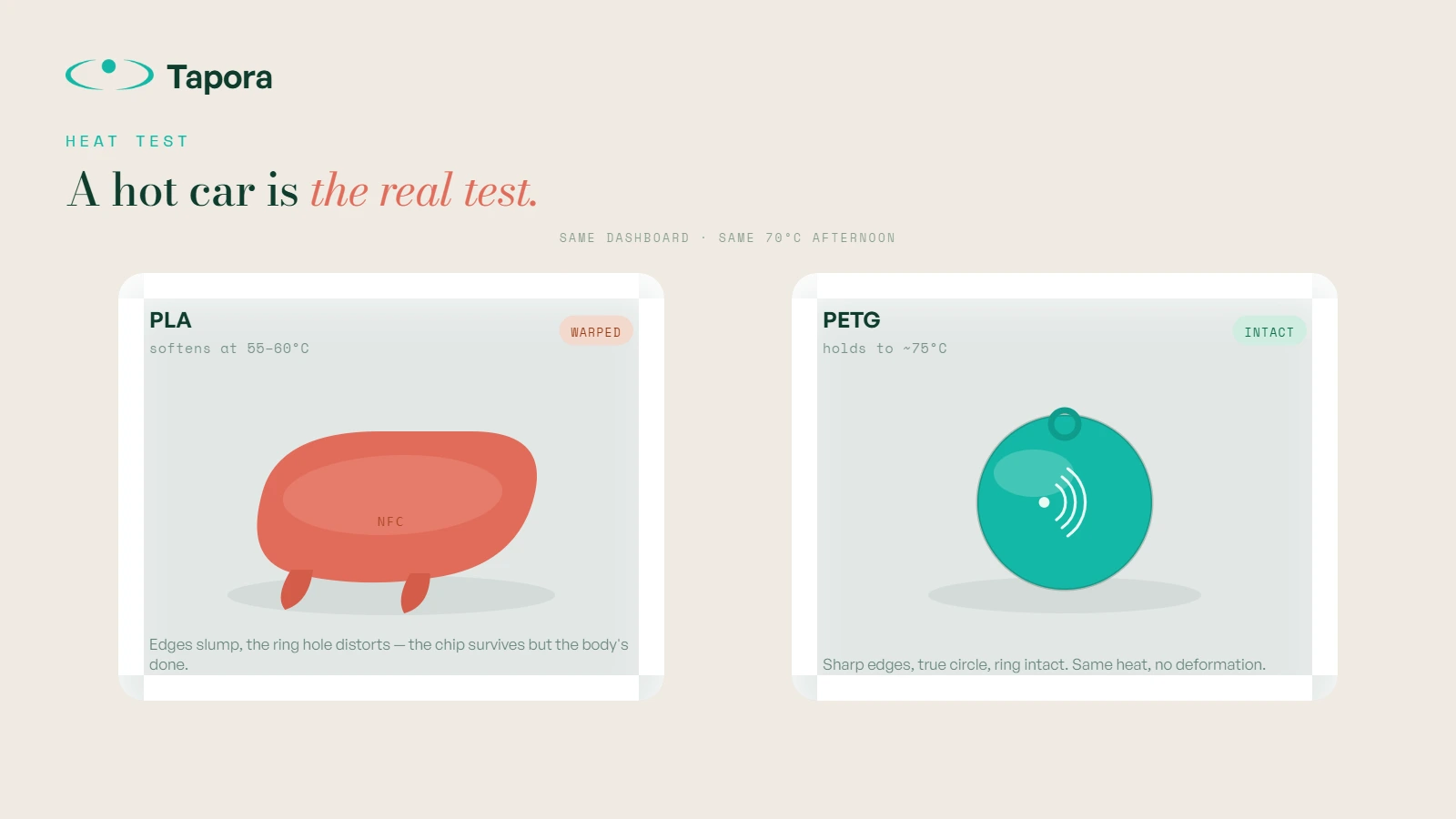
Strengths: sharp logo edges, vivid colour, low odour, low cost. Weaknesses: softens around 55–60°C. A PLA keychain left on a car dashboard in Mediterranean summer will deform.
PLA is great for indoor-use items, gift items, and products where visual quality outweighs durability.
PETG — the everyday-carry workhorse
PETG (polyethylene terephthalate glycol) is what most "premium" 3D-printed consumer products use. It's the same plastic family as water bottles, modified to be printable.
Strengths: ~75°C heat tolerance, much higher impact resistance than PLA, slightly flexible (resists snapping), UV-stable enough for outdoor use, food-safe grades available. Weaknesses: prints slightly less crisp than PLA, stringy if profiles aren't tuned, costs ~30% more.
PETG is the right answer for almost any item that lives in a pocket, on a keyring, or stuck outside a property. It's what Tapora uses for everyday-carry products.
ABS — the industrial option
ABS (acrylonitrile butadiene styrene) is what LEGO bricks are made of. Tough, heat-resistant up to ~100°C, machinable, paintable.
Strengths: highest heat tolerance of the three, most impact-resistant, post-processable (acetone smoothing). Weaknesses: warps badly during printing without an enclosed printer, emits fumes (needs ventilation), duller surface finish, harder to get consistent quality on small parts.
For consumer products at scale, ABS is overkill — its strengths matter mostly for automotive and industrial enclosures.
Quick comparison
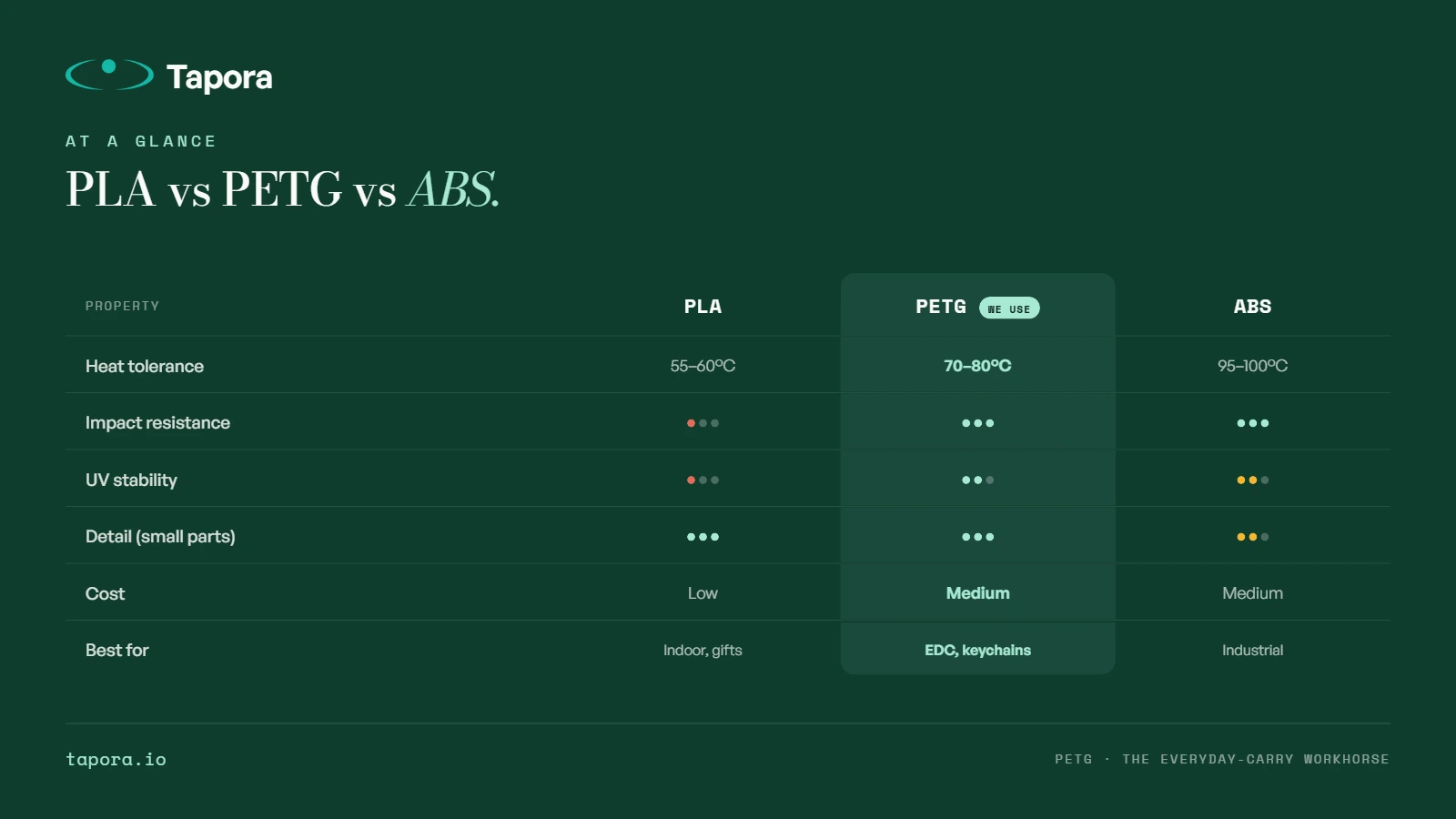
| Property | PLA | PETG | ABS |
|---|---|---|---|
| Heat tolerance | 55-60°C | 70-80°C | 95-100°C |
| Impact resistance | Low | High | Very high |
| UV stability | Poor | Good | Moderate |
| Print quality (small detail) | Excellent | Very good | Good |
| Cost | Low | Medium | Medium |
| Best for | Indoor decor, gifts | EDC, keychains, badges | Industrial, automotive |
What Tapora uses and why
For keychains and badges that live in pockets, on keyrings, and on doors in Mediterranean sunlight, we print in PETG. The heat tolerance is the deciding factor — a PLA keychain in a Malta-summer car is a sad keychain. PETG handles 70°C without deforming, which covers basically every real-world scenario short of a dishwasher.
For decorative or indoor-only batch orders where customers prioritise colour vibrancy, PLA is available on request.
How filament choice affects the NFC chip
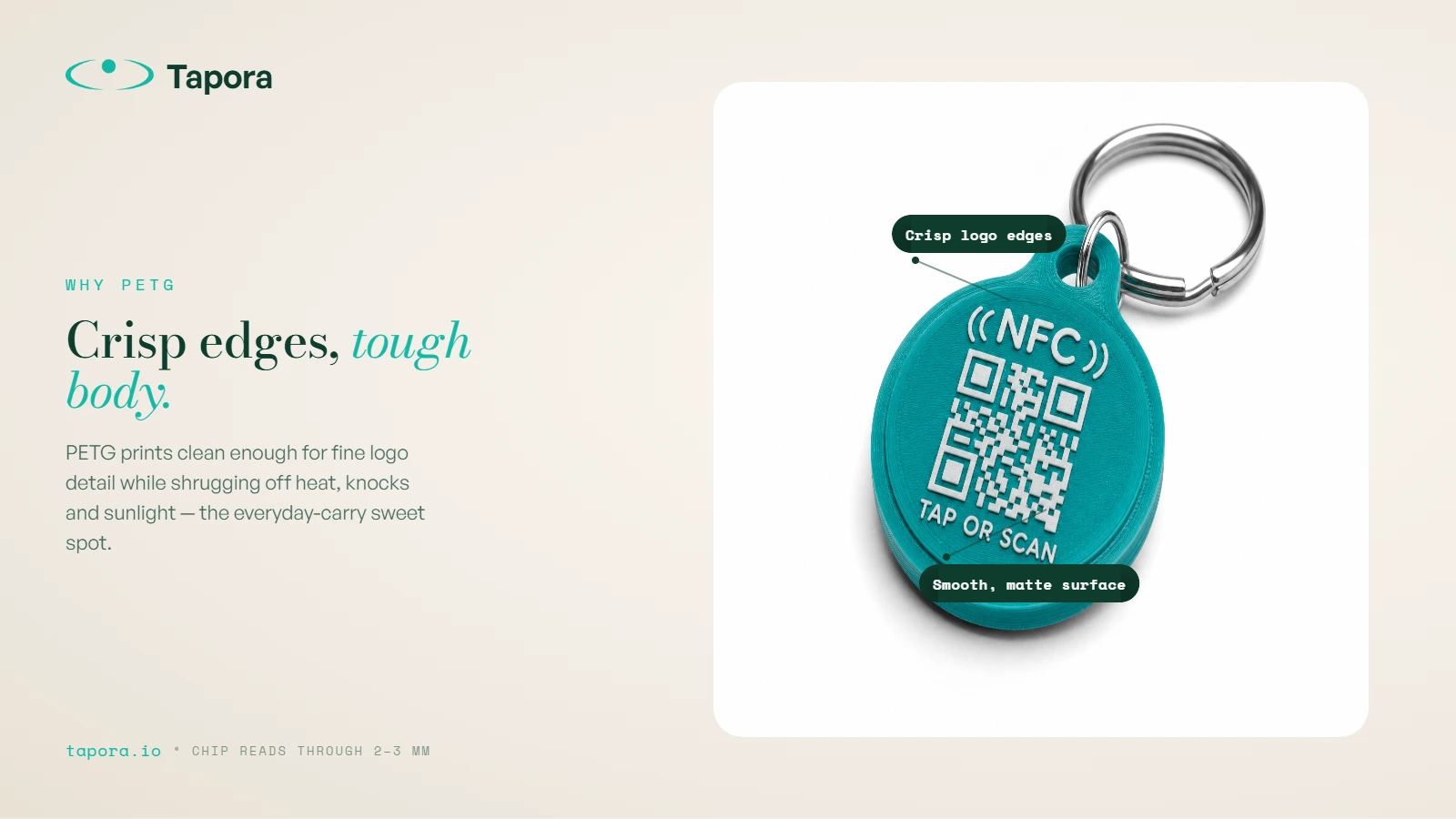
None of the three materials block NFC. The chip is embedded inside the printed body and reads through 2–3mm of plastic without measurable signal loss. What does matter is the print's temperature during chip insertion — chips inserted into still-warm prints can suffer, which is why we insert at room temperature only.
Wrap-up
Choosing filament isn't a flex about engineering — it's a quiet decision that determines whether a customer's keychain is still working a year later. We default to PETG because the failure modes of PLA show up exactly where customers actually use the product: in hot cars, on sunny windowsills, on outdoor signage. The cheaper material costs more in returns.
Continue reading
Guides
One Link, Many Destinations: Using Redirect Kinds to Run Campaigns
The smartest thing you can do with an NFC tag is not hardcode the destination. Tapora links don't point to your final URL — they point to a short URL you control, which means the same physical tag can route to a menu in January, a Valentine's promo in February, and a Google re…
Guides
Shipping From Malta to the EU and Beyond: What to Expect
Tapora prints and ships every order from Malta. For customers in Malta itself, that means next-day delivery. For the EU, it usually means 3–5 working days. For the rest of the world, it depends — and this post explains exactly what to expect, what we charge, and how customs ar…
Guides
Designing an SVG Logo That Prints Cleanly at 30mm
A logo that looks great on a business card can disappear entirely on a 30mm keychain. Two-colour 3D printing has physical constraints that vector design doesn't — stroke widths, minimum feature sizes, and contrast all matter differently. This guide covers how to design (or fix…