NFC vs QR Code: Which One Should Be On Your Product?
NFC tags and QR codes solve the same problem — getting a phone to a URL — in completely different ways. One is a chip you tap, the other is a pattern you point a camera at. Both work. The interesting question is which one belongs on your product, badge, or sign.
By Tapora team
NFC tags and QR codes solve the same problem — getting a phone to a URL — in completely different ways. One is a chip you tap, the other is a pattern you point a camera at. Both work. The interesting question is which one belongs on your product, badge, or sign.
This post lines them up side by side across the criteria that actually matter: friction, distance, durability, cost, and analytics. Tapora ships every unit with both, and the reason is at the end.
Friction: one tap vs three steps
NFC: hold phone near tag → URL opens. One motion. QR: unlock phone → open camera → frame the code → tap the popup. Three to four steps, and they fail in low light or behind glass.
For impulse moments — leaving a review, joining WiFi, viewing a menu — every extra second loses people. NFC wins on friction in any "tap-and-go" scenario.

Distance and orientation
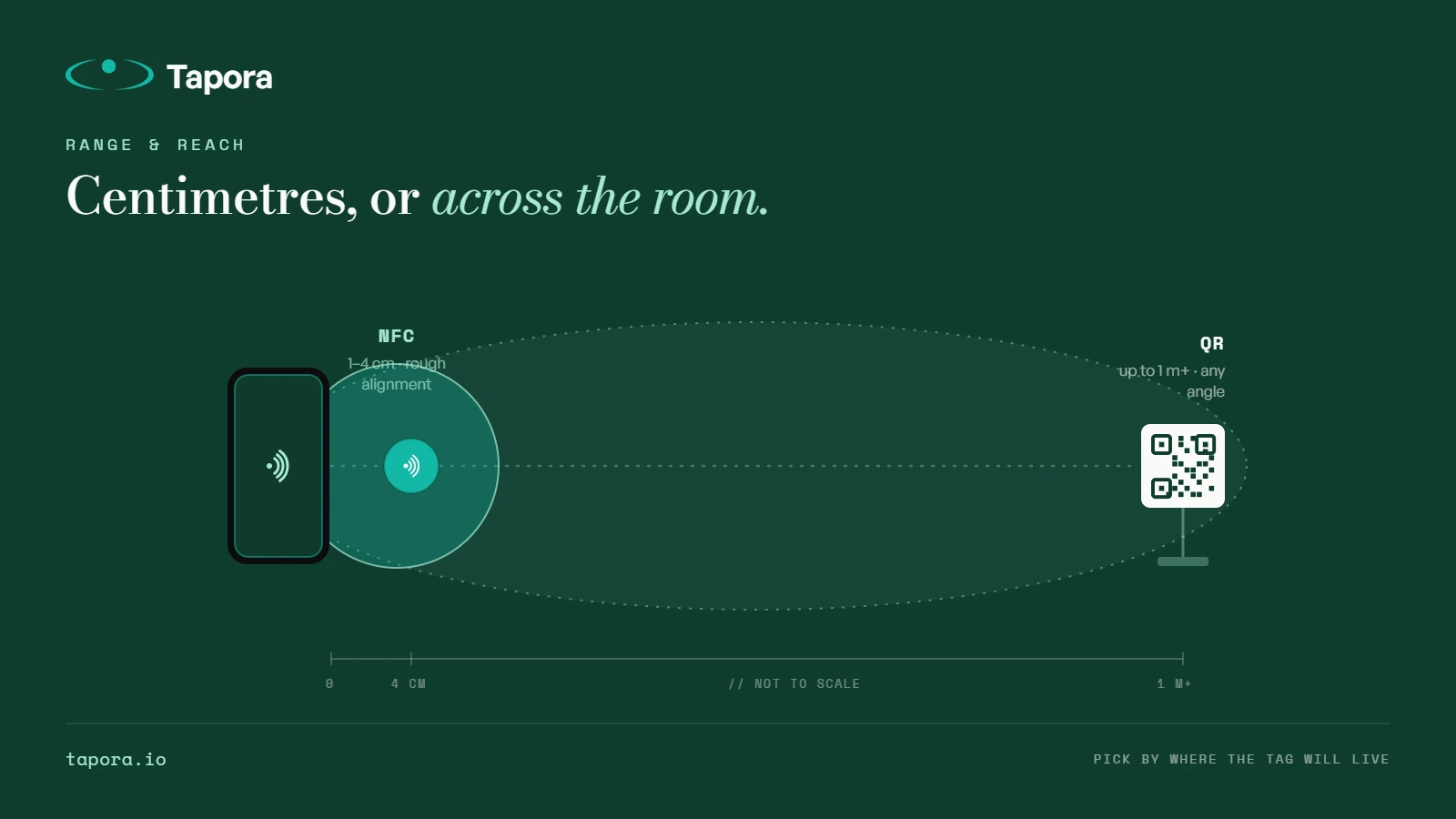
QR codes can be scanned from a metre away, from any angle, even off a screen. NFC requires roughly 1–4 cm and rough alignment. If your tag will be behind a counter, on a billboard, or shown on a TV — QR is the only option. If it'll be on a keychain, badge, or sticker at arm's reach — NFC is faster.
Durability in the real world
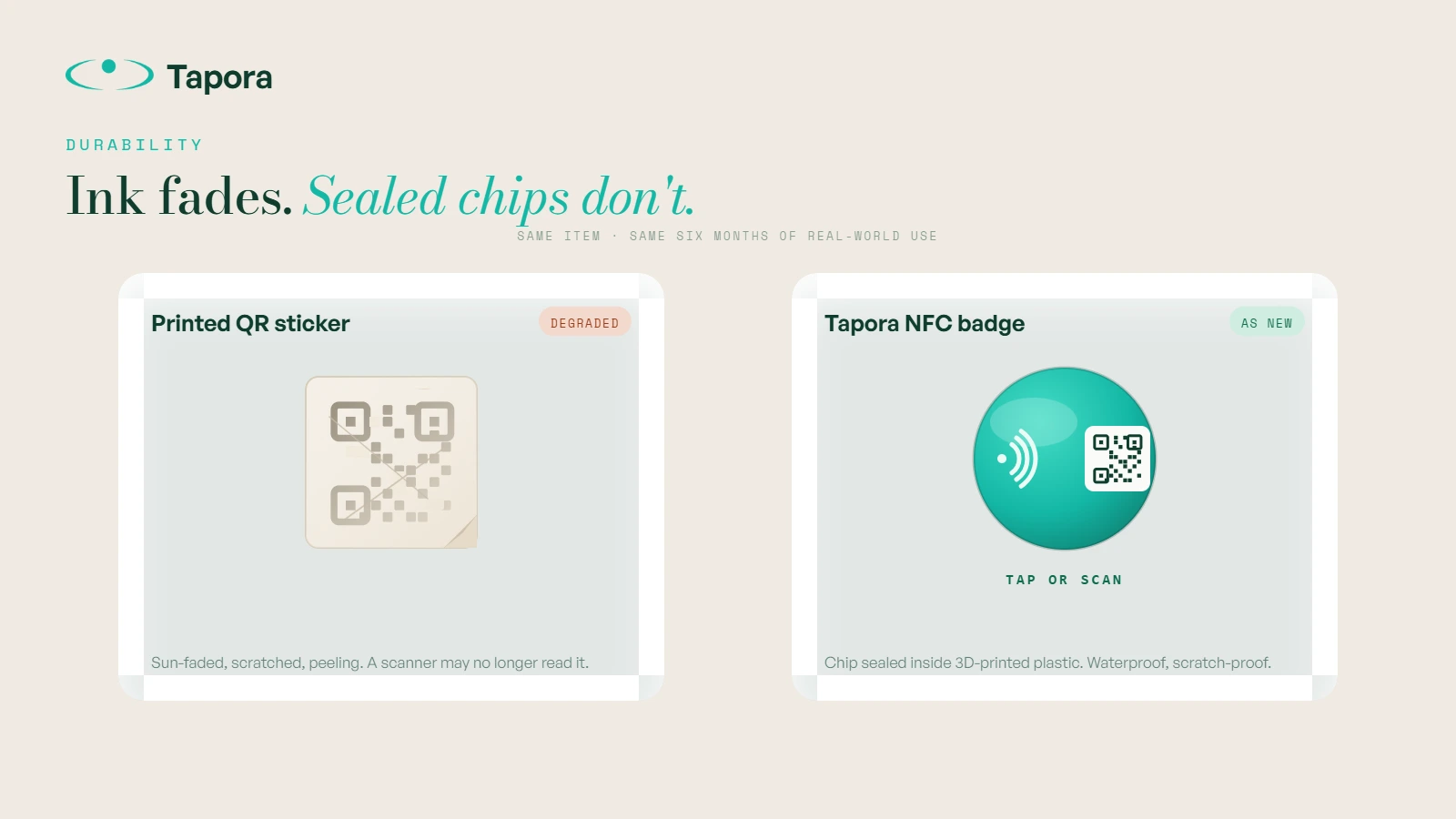
A QR code is just ink. Sun fades it, scratches break it, dirt obscures it. An NFC chip is sealed inside plastic — no exposed surface to damage. For outdoor signage or items that live in pockets, NFC outlasts printed codes by years.
Cost per unit at scale
QR codes cost essentially nothing to print. NFC tags cost cents at volume but aren't free. For a single-use leaflet, QR makes sense. For something a customer keeps — a keychain, a property badge, a loyalty token — the per-unit NFC cost is irrelevant against the value of the interaction.
Analytics
Both can route through a redirect service that logs scans, devices, and timestamps. There's no inherent analytics difference — what matters is whether the URL on the tag/code is a short URL you control. (Hardcoding a final destination kills analytics either way.)
Accessibility
QR codes require a working camera and decent lighting. NFC works in the dark, with a cracked screen, or for users who struggle to frame a camera steadily. For elderly users or accessibility-sensitive contexts, NFC is gentler.
Why Tapora ships both
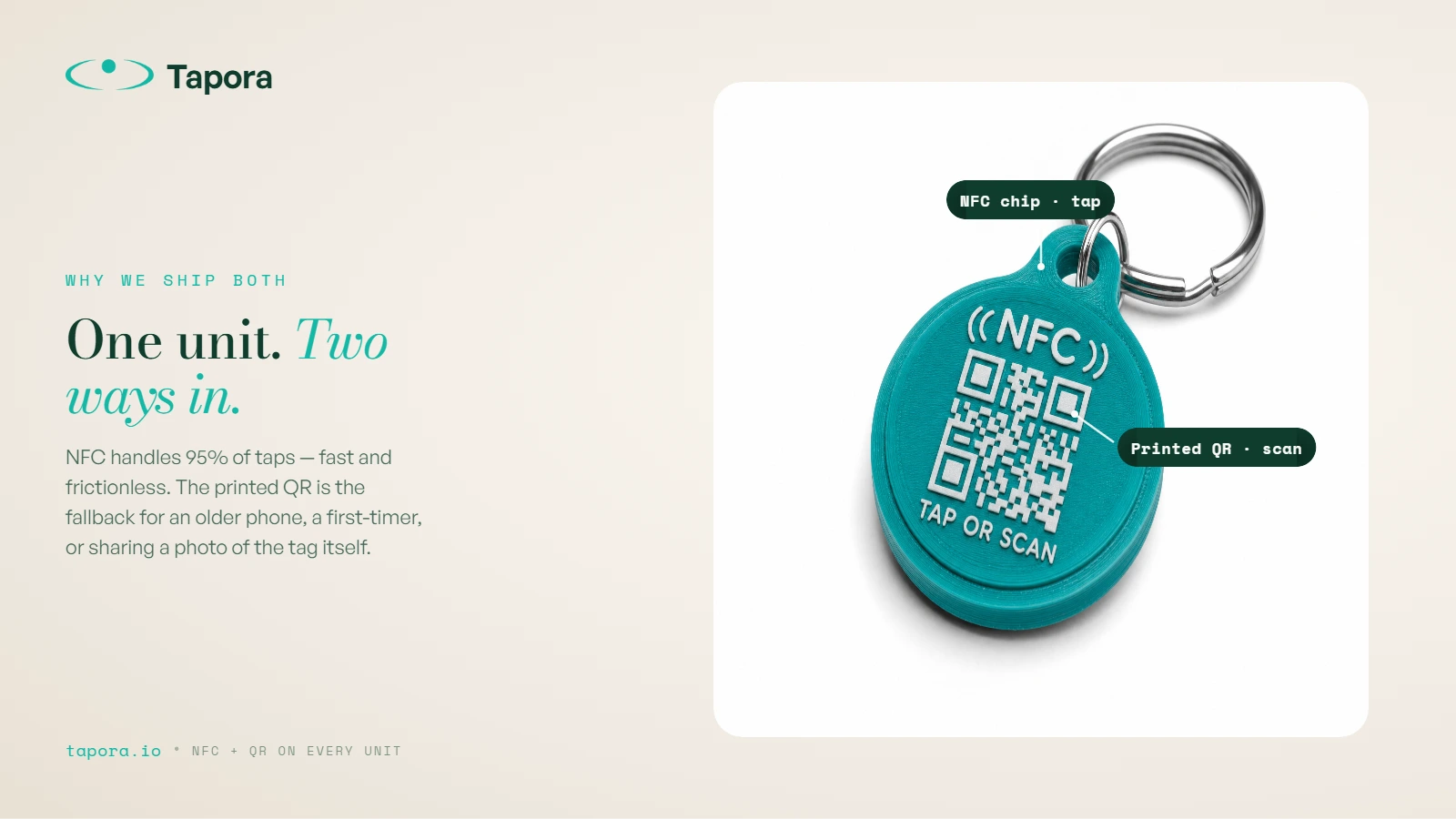
We put an NFC chip and a printed QR code on every keychain and badge. NFC handles 95% of taps — fast, frictionless. The QR is the fallback for the rare older phone, the user who's never tapped a tag before, or the moment when sharing means handing someone a photo of the tag instead of the tag itself.
Quick decision guide
- <strong>Customer keeps the item</strong> → NFC (with QR fallback)
- <strong>Item is far away or on a screen</strong> → QR
- <strong>Outdoor / harsh environment</strong> → NFC
- <strong>Single-use disposable print</strong> → QR
- <strong>High-friction moment matters</strong> (reviews, check-in, payment) → NFC
Wrap-up
NFC vs QR isn't really a competition — they're tools for different distances and different lifespans. The mistake is picking one when you could ship both, especially on a product designed to be tapped over and over.
Continue reading
Guides
One Link, Many Destinations: Using Redirect Kinds to Run Campaigns
The smartest thing you can do with an NFC tag is not hardcode the destination. Tapora links don't point to your final URL — they point to a short URL you control, which means the same physical tag can route to a menu in January, a Valentine's promo in February, and a Google re…
Guides
Shipping From Malta to the EU and Beyond: What to Expect
Tapora prints and ships every order from Malta. For customers in Malta itself, that means next-day delivery. For the EU, it usually means 3–5 working days. For the rest of the world, it depends — and this post explains exactly what to expect, what we charge, and how customs ar…
Guides
Designing an SVG Logo That Prints Cleanly at 30mm
A logo that looks great on a business card can disappear entirely on a 30mm keychain. Two-colour 3D printing has physical constraints that vector design doesn't — stroke widths, minimum feature sizes, and contrast all matter differently. This guide covers how to design (or fix…